Home Buyer Due-Diligence Checklist: What to Check Before the Offer, During the Inspection and Before Closing
A free, printable U.S. home-buyer checklist in three stages: before you make an offer, during the inspection window and before closing. Includes links to official guidance and free Ampian AI sample reports.

Written by Toan Vo · Last updated
This article was drafted with AI help, reviewed, and approved by Toan Vo.
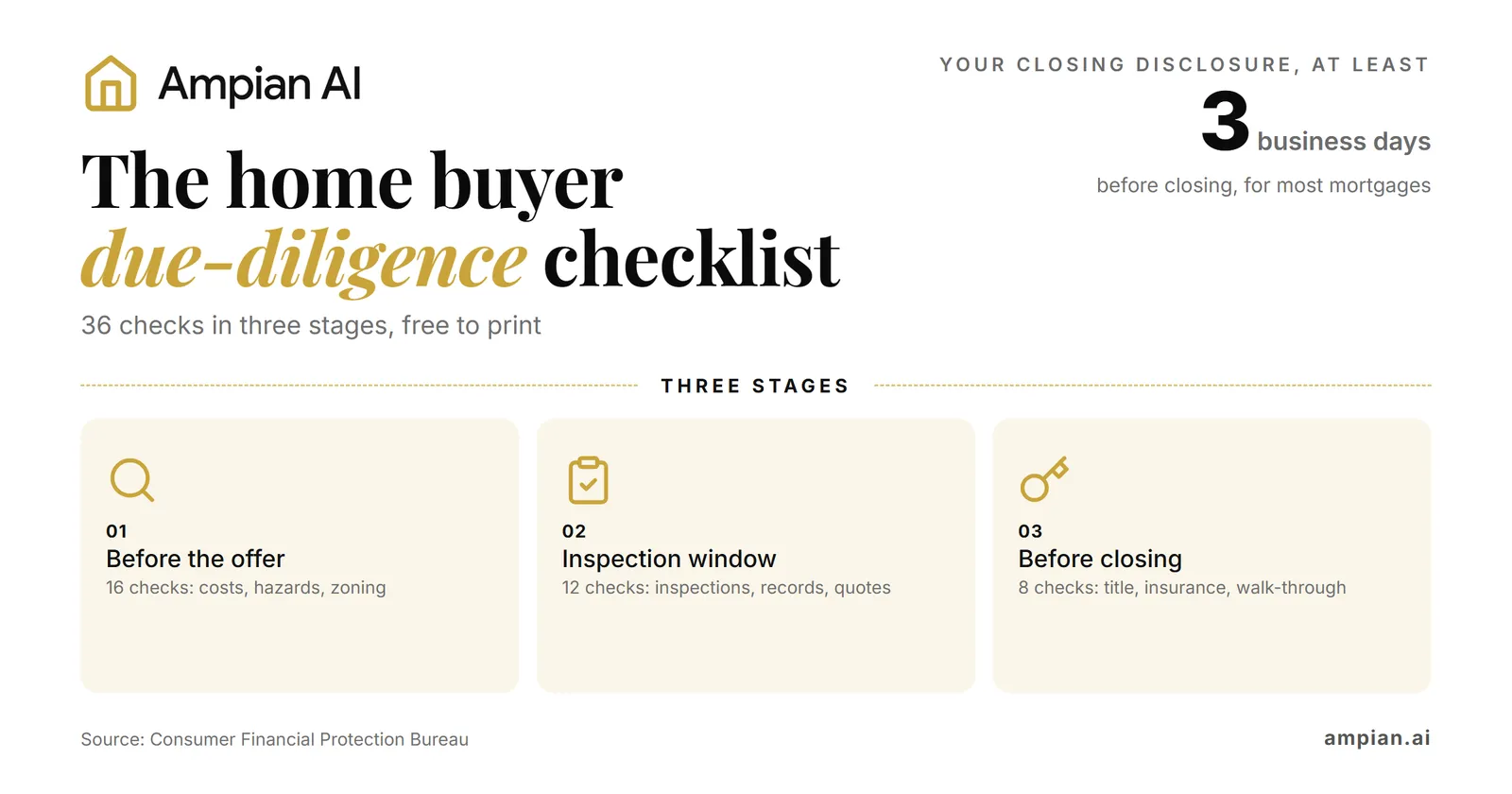
Home buyer due diligence means checking a property’s costs, condition and legal restrictions before you commit to buying it. This checklist organizes those checks into three stages: before the offer, during the inspection window and before closing. For most mortgages, you must receive your Closing Disclosure, which lists your final loan terms and costs, at least three business days before closing1.
Use the full checklist below without signing up. Each step explains what to check and where to start. Links to Ampian AI sample reports show the cost estimates and property information our reports provide. Steps that require other records, professional inspections or closing documents are marked Not in our report.
To print this checklist, use your browser’s Print command: Ctrl+P on Windows or Cmd+P on a Mac. On a phone, look for Print in the browser’s Share or menu options.
Key takeaways
- Check the home in three stages: before the offer, during the inspection window and before closing. Confirm your contract’s deadlines early so you have time to review the findings.
- Before the offer, estimate ownership costs and check the location: the property tax you will pay, homeowners insurance, utilities, repairs, flood and other hazards, and what zoning allows nearby. Our free Ampian AI True Cost Forecaster sample report and Ampian AI Zoning Oracle sample report show what we offer to jumpstart your due diligence.
- The inspection window is about the house itself. A data report can’t replace the home inspection, a radon test, a sewer line check or the seller’s insurance claims history. Those steps are marked Not in our report.
- The EPA recommends testing for radon when buying a home, and fixing the home if the level is 4 picocuries per liter (pCi/L) or higher9. Nearly one out of every 15 U.S. homes is estimated to be at that level9.
- Before closing, compare your Closing Disclosure with your latest Loan Estimate1. Confirm wiring instructions by phone using a number you have already verified18.
Before you make an offer
These checks help you estimate monthly costs and understand what could affect the property or surrounding area.
During the inspection window
If your contract includes an inspection period, confirm its deadline and your options for requesting repairs or canceling. Schedule inspections early enough to review the results.
Before closing
Use the final days to review documents, confirm insurance coverage and check the home’s condition once more.
What the free official tools already do well
Many research steps start with free resources. The Consumer Financial Protection Bureau (CFPB) explains mortgages and closing in its guides and mortgage closing checklist. FEMA’s Flood Map Service Center lets you enter an address and see the official flood map5. The Wildfire Risk to Communities site was created by the USDA Forest Service to show long-term wildfire risk6. The EPA explains radon testing and lead-paint disclosure requirements79.
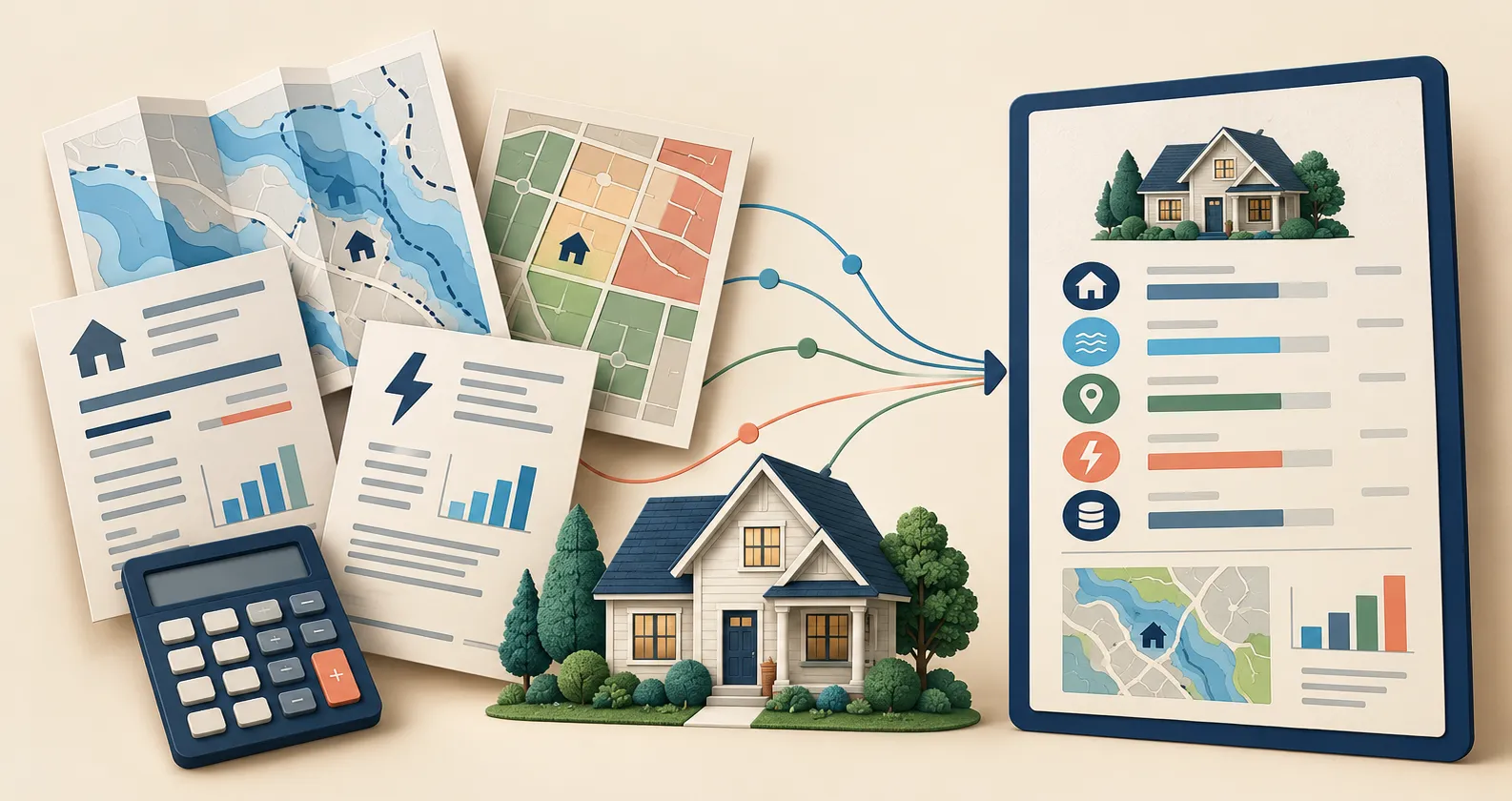
These resources answer specific questions. Ampian AI brings estimated ownership costs into the True Cost Forecaster and zoning, hazard ratings and neighborhood information into the Zoning Oracle, helping you organize research for an address.
How Ampian AI checks this
Our two free sample reports show how Ampian AI presents this information. They are real reports for two real addresses, saved at one point in time, so their figures may not match today’s market.
The True Cost Forecaster sample covers an early-1900s Dorchester house. It breaks the yearly cost into separate items, including property taxes of $9,3842 to $14,292 a year2, heating oil of $1,8122 to $5,016 a year2 and a repair fund (Capital Expenditures) of $11,0672 to $17,616 a year2. Each item explains what drives it, such as the home’s aging oil-fired steam heating system.
The Ampian AI Zoning Oracle sample describes a Redondo Beach home. It lists RMD zoning for housing with multiple units and says accessory dwelling units (ADUs), such as a separate backyard home, are permitted3. It shows a Minimal flood rating and a Relatively High earthquake rating3, five development projects reported in the area3, and that short-term rentals are not permitted at the zone level3. Use these findings to guide further checks with local authorities; they do not establish building approval or the home’s safety.
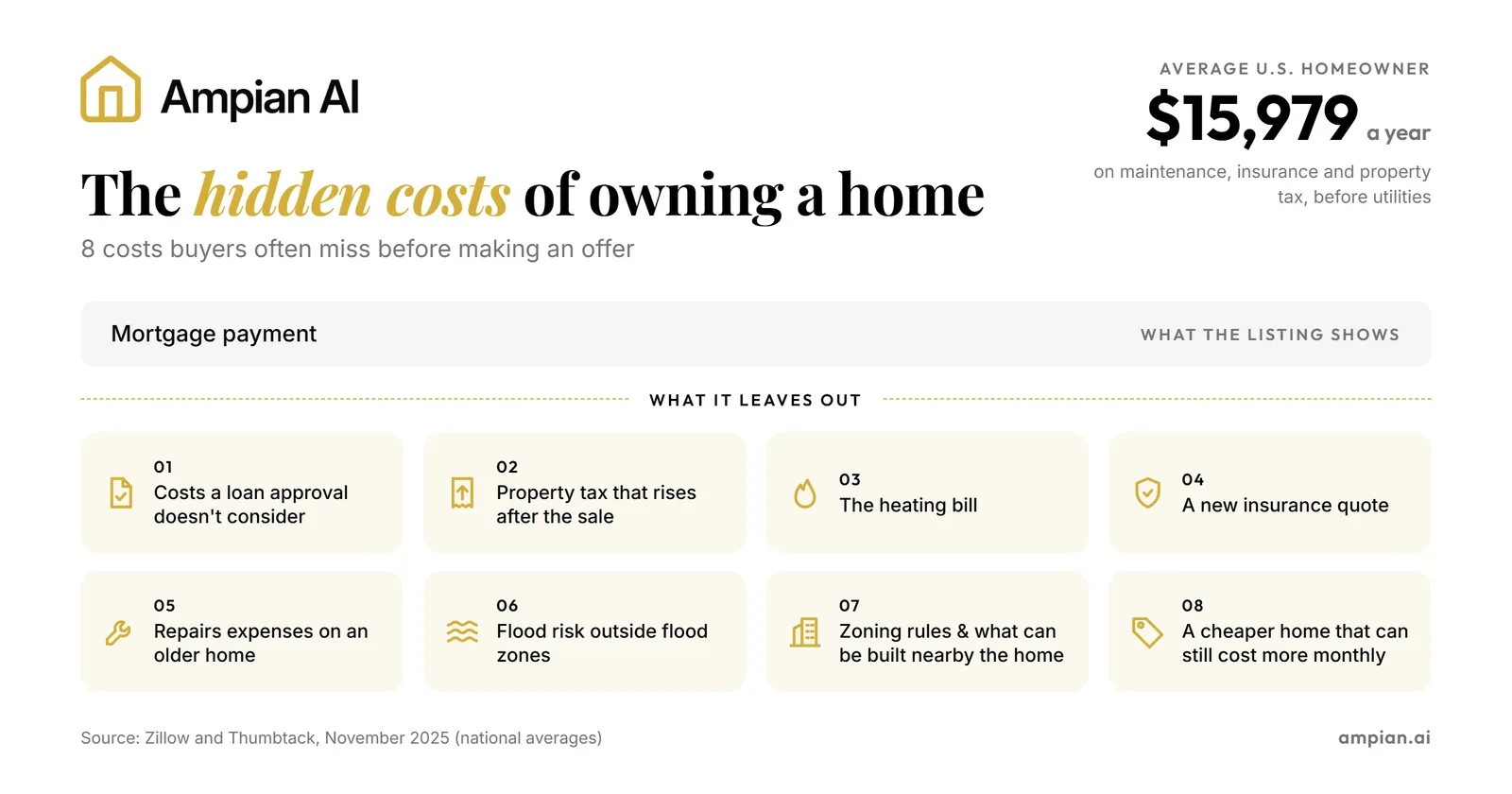
Ampian AI helps with pre-purchase cost and location research. Neither report inspects the house, searches the title or reads your closing papers. Use it alongside the professional and official checks marked Not in our report. For the cost and risk checks, you can see what a report costs or read the hidden costs of owning a home first.
Frequently asked questions
What should be on a home buyer due diligence checklist?
Before the offer, check the costs you will really pay: property tax at your price, insurance, utilities, upkeep and a repair fund. Also check flood and other hazards, zoning and planned building nearby. During the inspection window, get the home inspection, a radon test, a sewer line check and the seller’s insurance claims report. Before closing, review your Closing Disclosure, protect your closing money from wire scams and do a final walk-through.
When should I get a home inspection?
Schedule an independent inspection as soon as possible after choosing a home, with time for follow-up checks before your contract’s deadline. Your ability to request repairs or cancel depends on the contract8.
How many days before closing do I get the Closing Disclosure?
For most mortgages, you must receive it at least three business days before closing. Compare the final loan terms and costs with your latest Loan Estimate, and ask your lender to explain differences before you sign1.
Can I get the C.L.U.E. report on a house I am buying?
Ask the seller to request and share it. Prospective buyers cannot obtain the owner’s report directly. C.L.U.E. generally includes up to seven years of reported insurance claims; it is not a complete record of every repair or problem at the home12.
Should I test a house for radon before buying?
Yes. The EPA recommends testing when buying a home. Radon is a radioactive gas you cannot see or smell. The EPA recommends reducing levels of 4 pCi/L or higher, and notes that lower levels can still pose a risk9.
Sources
- Consumer Financial Protection Bureau, Review documents before closing
- Ampian AI, True Cost Forecaster sample report
- Ampian AI, Zoning Oracle sample report
- Consumer Financial Protection Bureau, Loan Estimate explainer
- FEMA, Flood Map Service Center
- USDA Forest Service, Wildfire Risk to Communities
- U.S. EPA, Real Estate Disclosures about Potential Lead Hazards
- Consumer Financial Protection Bureau, Schedule a home inspection
- U.S. EPA, Home Buyer's and Seller's Guide to Radon, March 2024 (revised)
- Tampa Bay Estuary Program, Pipe Up (lateral sewer lines)
- U.S. EPA, How to Care for Your Septic System
- Washington State Office of the Insurance Commissioner, CLUE
- Utah Department of Commerce, HOA Homebuyers
- Consumer Financial Protection Bureau, Shop for homeowner's insurance
- FloodSmart (National Flood Insurance Program), Buy a Flood Insurance Policy
- Consumer Financial Protection Bureau, Shop for title insurance and other closing services
- Consumer Financial Protection Bureau, What is owner's title insurance?
- Consumer Financial Protection Bureau, Your mortgage closing checklist
- Consumer Financial Protection Bureau, Close the deal
- FloodSmart (National Flood Insurance Program), What Is My Flood Zone?