Will My Property Tax Go Up After I Buy? What Happens to the Seller's Caps and Exemptions
Often, yes. Buying a home can end tax benefits that kept the seller's bill low. Learn how the rules differ by state, which benefits you need to apply for, and how to estimate your property tax before you buy.

Written by Toan Vo · Last updated
This article was drafted with AI help, reviewed, and approved by Toan Vo.

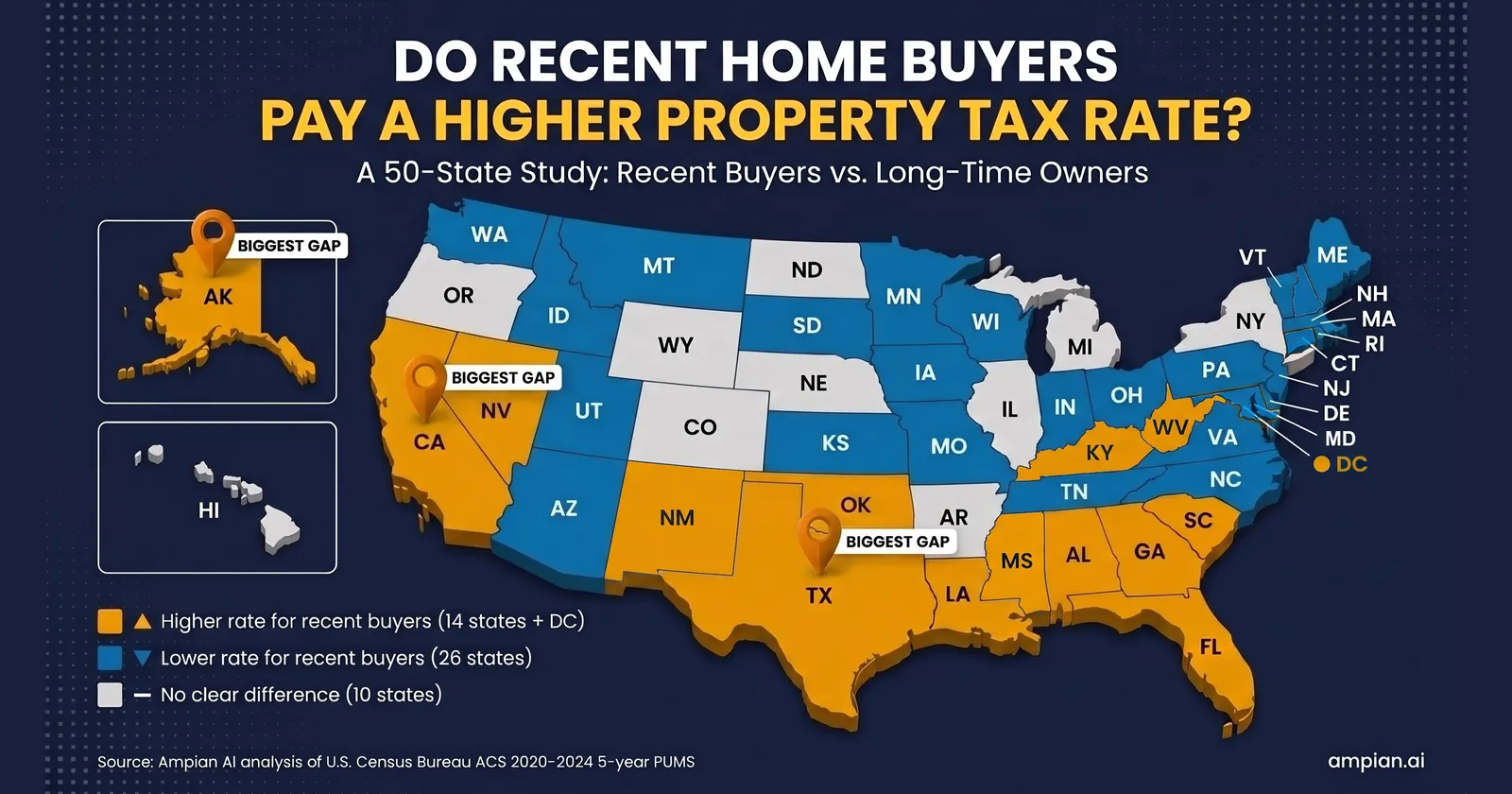
Your property tax can go up after you buy a home. A sale can remove the seller’s tax benefits and increase the value used to calculate the bill. In Florida, for example, the seller’s assessment cap generally ends, and the home is valued at market value the following January 11. The tax shown on a listing reflects the current owner’s situation. Your bill may be higher, even if the increase does not appear right after closing.
Key takeaways
- A typical home sale can end the seller’s assessment cap or tax credit in the nine states California, Florida, Maryland, Michigan, Texas, Oklahoma, New Mexico, South Carolina, Arkansas and the District of Columbia. The timing and exceptions vary.
- The increase may arrive the following year. In Florida and Michigan, the reset takes effect in the year after you buy27, so your first bill can still reflect the seller’s benefits.
- California may send a separate supplemental tax bill directly to you, and your lender does not receive it4.
- Do not assume you qualify for the seller’s exemptions. Some benefits remain on the property temporarily, but you generally need to establish your own eligibility.
- Some states also revalue every home on a fixed schedule. Maryland values homes once every three years6, and South Carolina on a five-year cycle15. In both, a sale still ends the seller’s cap or triggers a new appraisal.
- To estimate your own bill, apply the local tax rate to the value the home is likely to have after the sale, minus the exemptions you will apply for. Then confirm with the county’s tax assessor.
Why the seller’s bill is not your bill
We cover the basics in our guide on hidden costs to explain why the property tax on the listing isn’t necessarily yours. In short, a cap limits how quickly a home’s value can rise for tax purposes. Over time, that value can fall well below market value1. When the home sells, many states end that cap, and the new owner starts over.
Below, we explain the rules using official sources and show what to check before making an offer. An assessment is the official valuation used for taxes. The caps discussed here generally limit that value’s growth. Tax rates and other charges can still change what you pay.
What happens to the seller’s cap when a home sells
| State | The rule | What happens on sale | Official page |
|---|---|---|---|
| Arkansas | A homestead’s taxable value can rise only 5%16 a year until it reaches full assessed value16 | Values are reassessed when a home is sold21 | Arkansas DFA |
| California | Proposition 13 generally establishes a new assessed value when a home is bought3 | The home is reassessed to its current market value as of the sale date, plus a supplemental bill34 | California BOE |
| District of Columbia | The Assessment Cap Credit generally limits the assessed-value increase subject to tax to 10% a year17 | An existing seller’s cap credit can remain only for the half of the tax year in which the purchase occurs17 | DC Office of Tax and Revenue |
| Florida | Save Our Homes limits a homestead’s yearly increase to 3% or the change in the Consumer Price Index, whichever is less1 | The home is assessed at market value on the January 1 after the sale1 | Florida Department of Revenue |
| Maryland | The Homestead Tax Credit limits annual increases in the assessment subject to tax to 10% or less5 | The buyer loses the seller’s credit and pays on the assessment applicable to the property6 | Maryland SDAT |
| Michigan | Taxable value generally increases by no more than 5% or inflation, whichever is lower8 | The seller’s cap generally ends in the calendar year after purchase7 | Michigan Treasury |
| New Mexico | Residential property values generally have a 3% annual growth limit14 | A typical sale removes the limit for the next tax year’s valuation14 | Bernalillo County Assessor |
| Oklahoma | Value increases for tax purposes are generally capped at 3%13 for homesteads and farmland, and 5% for other real property13 | A typical sale removes the seller’s cap and brings the valuation to market value12 | Oklahoma Tax Commission |
| South Carolina | Increases from countywide reassessment are generally capped at 15% over five years15 | A qualifying ownership transfer triggers a new appraisal outside that cap15 | South Carolina DOR |
| Texas | A qualifying homestead’s appraised value generally cannot rise more than 10% a year, plus new improvements10 | The seller’s cap expires; your own cap starts later under the homestead eligibility rules10 | Texas Comptroller |
These examples cover ordinary home purchases, not every type of ownership transfer. Some family transfers and other transactions qualify for exceptions137. Other states have assessment limits too. Use current state and local guidance to check a specific purchase.
California: reassessed at the sale, then a supplemental bill
In California, when a home is sold, Proposition 13 requires the county assessor to reassess it to its current fair market value as of the date ownership changed3. In most home purchases, the whole property is reassessed3. If the market value is lower than the seller’s adjusted value, your taxes go down instead3.
The surprise for many buyers is the supplemental bill. The reassessment takes effect right away through a separate bill that covers the period from the first day of the month after the sale to the end of the fiscal year, June 304. If you buy between January 1 and May 31, you can get two supplemental bills, including one for the following fiscal year4. A lower assessment may produce a refund instead4.
Lenders do not receive supplemental bills, even when they pay your annual bill from an escrow account4. The bill goes to you, and the state does not excuse late penalties caused by a mix-up with your lender4.
Before you offer: Ask the county assessor what the home’s value is likely to be at your price, and set money aside for a supplemental bill. When it arrives, pay it or ask your lender in writing who will.
Florida: Save Our Homes ends, but portability can help
Florida’s Save Our Homes cap starts in the year after a home first receives a homestead exemption. It limits annual assessment increases to 3% or inflation, whichever is lower. A typical sale removes that protection for the following January 11.
The Florida Department of Revenue says many first-time Florida homeowners are surprised when their bill is higher than the previous owner’s2. The seller’s exemption and Save Our Homes benefit stay with the home for the rest of the calendar year you buy in, so your first bill may still show them2.
The state’s 2024 brochure illustrates this with a September purchase. The home’s assessed value was $110,0002 and its taxable value $60,000 under the seller2. After the new assessment and the buyer’s own homestead exemption, the assessed value rose to $130,0002 and the taxable value to $80,0002.
If you are moving from one Florida homestead to another, portability may let you carry all or part of your old Save Our Homes benefit to the new home1. You must set up the new homestead within three years of January 1 of the year you left the old one, not three years after the sale1. You file the transfer form with your homestead application by March 11.
Before you offer: Compare the home’s market value and assessed value on the county property appraiser’s website. A large gap can signal a substantial increase after purchase2.
Maryland: the homestead credit stops, and you apply for your own
Maryland’s Homestead Tax Credit limits annual increases in the assessment subject to tax on an eligible main home. State law requires county and municipal limits of 10% or less5.
A buyer does not keep the seller’s accumulated credit. Your bill is based on the property’s applicable assessment without that credit. You may qualify for protection against later increases, but that does not preserve the seller’s lower starting point6.
You must apply to establish your eligibility. SDAT says it mails applications after updating its records for a purchase, and the person handling settlement must provide information about the credit5.
Before you offer: Look up the home on the state’s Real Property search5 and ask the local assessment what value will apply without the seller’s credit. Plan to file your homestead application soon after you move in.
Michigan: the taxable value “uncaps” the year after you buy
Michigan generally limits annual growth in taxable value to 5% or inflation, whichever is lower, excluding additions and losses. After a typical sale, that limit is removed for the following calendar year7. Taxable value then equals that year’s state equalized value, which represents 50% of the home’s estimated market value8.
Michigan law does not let the assessor simply use your price. The State Tax Commission says the assessor must value a sold home the same way as homes that did not sell, and may not automatically set its value at half the sale price8.
Michigan also has a principal residence exemption, which exempts your main home from the local school operating tax of up to 18 mills, or $189 per $1,0009 of taxable value. Ask your city or township assessor how to claim it for your new home.
Before you offer: Ask for an estimate of next year’s state equalized value. The current figure can help you plan, but next year’s figure determines the value after the cap ends8.
Other states where the cap ends at the sale
- Texas. The 10% homestead cap limits annual growth in appraised value, excluding new improvements10. That limit starts on January 1 of the tax year after the owner qualifies for the homestead exemption, and ends on January 1 after the owner stops qualifying10. In other words, the seller’s cap does not carry over. Yours starts once you qualify.
- Oklahoma. Taxable value can rise no more than 3% a year13 for homesteads and farmland, and 5% for other property13. The limit lasts only as long as title is not transferred12. Tulsa County warns that a buyer’s bill can rise substantially when the seller’s capped value is replaced with market value13.
- New Mexico. Bernalillo County’s assessor says a buyer may pay on the seller’s value in the year of purchase, which is often below market value because of the 3% cap14. The value is brought to market value the next tax year14.
- South Carolina. Counties reappraise every five years, and those increases are limited to 15% within five years15. A sale or other “assessable transfer of interest” triggers a new appraisal, and the 15% cap does not apply in that year15.
- Arkansas. A homestead’s taxable value can rise only 5%16 a year until it reaches full assessed value. Values are reassessed when a home is sold21.
- District of Columbia. The Assessment Cap Credit limits the taxed increase to 10 percent a year17. A buyer gets the seller’s cap credit only for the tax half in which the home was bought. Their own cap usually starts within a year of applying for the Homestead Deduction17.
Reassessed at sale, or on a schedule?
Two processes can affect a home’s assessed value, and some places use both.
At the sale. California generally uses market value at the purchase date3. Florida and Michigan generally apply the value change resulting from the sale in the following year17.
On a schedule. Maryland reassesses each property every three years and phases in increases over three years6. South Carolina generally reappraises countywide every five years15. A sale can separately remove a Maryland credit or trigger a South Carolina appraisal615.
Where a sale does not trigger a reset, the existing assessment may remain until the next valuation. Your bill can still change because of new tax rates, reassessment, or a change in exemption eligibility.
The seller’s exemption does not move to you
A homestead benefit usually applies to an eligible owner’s main home. An exemption reduces the value subject to tax; a credit reduces the bill. Some benefits remain on the property for the rest of a tax year, but you should not assume they will continue under your ownership216. Here is what buyers need to check:
- Florida. Qualifying owners receive a $25,00018 exemption that applies to all taxes, including school taxes, plus an additional exemption for non-school taxes. For 2026, that additional amount is $26,41118. Generally, you must own and occupy the home on January 1 and apply by March 12. Florida voters decide on November 3, 2026 whether to change these exemptions from 2027; check the current amount with your county property appraiser18.
- Texas. Apply to the county appraisal district. The general deadline is before May 111. A buyer who qualifies after January 1 may receive a partial-year exemption if the seller did not receive the same exemption that year11.
- Maryland. Apply once for the Homestead Tax Credit5. The standard deadline is May 1 before the first tax year for which the credit is allowed; ask SDAT which year applies to your purchase6.
- South Carolina. Apply for the main-home classification, which generally uses 4%15 of market value instead of 6%, but only after the owner applies and the county assessor approves15.
- Arkansas. Apply through the county assessor. The homestead credit is up to $50016 a year, and the state has allowed up to $60016 starting with 2026 tax bills. It reduces the tax bill, not the property’s assessed value16.
- District of Columbia. Apply for the Homestead Deduction. Approved applications filed October 1 through March 31 qualify for the full tax-year benefit; April 1 through September 30 filings receive half17.
- California. The homeowners’ exemption removes up to $7,0004 from taxable value. If the seller had not claimed it, moving in within 90 days may qualify you for supplemental-tax relief4. File your claim as soon as you get the supplemental notice; your county assessor sets the deadline.
- New Mexico (Bernalillo County). The head-of-family exemption reduces taxable value by $2,000 for qualifying owners. The usual application deadline is 30 days after the assessor mails the Notice of Value. Check the notice rather than assuming an April deadline14.
Before you offer: Find the application and eligibility rules on the official assessment office website. Note both the filing deadline and the date by which you must own and occupy the home. Timing matters, for example, in Florida, the exemption shows on that year’s bill only if you apply by March 12.
How to estimate your own bill
Use official records and local tax calculators to estimate the cost before making an offer:
- Find the local tax rate. Ask the local tax office for the rates that apply to the address. Rates are written in different ways. For example, Maryland’s example uses dollars per $100 of value5, and South Carolina uses mills, where a mill is one-thousandth of a dollar15.
- Estimate the value after the sale. Ask the assessor how the purchase will affect the assessment. In a state where the cap ends at sale, expect the home’s taxable value to move toward its market value. Michigan, for example, warns that the new value is set by the assessor, not copied from the price8.
- Apply the exemptions you qualify for. Subtract approved value exemptions before calculating tax, and deduct tax credits afterward. Check each benefit’s rules: an exemption may apply to some taxes but not others9.
- Calculate the tax. Multiply the taxable value for each taxing authority by its rate, then total the amounts. For example, in Michigan, the taxable value multiplied by the millage rate gives the property tax8. Maryland’s own example uses a rate of $1.045 per $1005: on $10,0005 of value, that is $1045.
- Confirm with the assessor or tax office. Florida’s Department of Revenue suggests asking the county property appraiser’s office before you buy, and notes that some appraisers’ websites can estimate your tax2.
If your taxes are paid through escrow, a higher tax bill after the sale also raises your monthly mortgage payment, because escrow is the part of your payment set aside for expenses such as taxes and insurance20. Budget separately for any supplemental bill that the lender will not cover4.
Before you offer: Repeat this calculation for each home on your shortlist. Compare the expected annual tax and divide it by 12 to see its effect on your monthly budget.
How Ampian AI checks this
Official records and local tax offices establish the assessment, eligibility rules, and tax charges for each home. Online calculators can help you plan, but their estimates are not final bills.
The Ampian AI True Cost Forecaster bases the property tax line on the purchase price rather than the seller’s bill. In our free True Cost Forecaster sample report, the early-1900s Dorchester house shows property taxes of $9,38419 to $14,292 a year19. The sample uses the purchase price as an estimate of market value. It assumes you will live in the home as your main residence, so it applies a residential (homestead) exemption19.
Use the forecast range to compare homes and plan your budget, then confirm the local assessment and any exemptions you qualify for. You still need to complete any required exemption application. Plans and report prices are on our Pricing page.
For the other costs a listing leaves out, see the hidden costs of owning a home and our home buyer due diligence checklist.
Frequently asked questions
Does a house get reassessed when it sells?
It depends on the state and the type of transfer. California generally reassesses at purchase, while Michigan generally removes the seller’s taxable-value cap the following year37. Other places follow different schedules. Ask the local assessor whether the sale changes the value and when that change will affect your bill.
Does the seller’s homestead exemption transfer to the buyer?
Do not assume it does. A seller’s benefit may remain on the property temporarily, as in Florida during the year of purchase2. To receive benefits afterward, you generally need to qualify and apply yourself. Check the local rules as soon as you buy.
What is a supplemental tax bill in California?
When a California home changes hands, the county reassesses it and sends the new owner an extra bill for the rest of the tax year. It comes on top of the regular yearly bill. Lenders do not receive it, so even if your taxes are paid through escrow, you need to pay it or ask your lender who will.
How do I estimate the property tax on a house I’m buying?
Ask the assessor for the likely value after purchase and check how much of that value is taxable. Apply the exemptions and tax rates relevant to you, then account for credits and separate charges. A local tax calculator or tax office can help confirm the estimate.
Sources
- Florida Department of Revenue, Save Our Homes Assessment Limitation and Portability Transfer (PT-112, R. 08/24)
- Florida Department of Revenue, Property Tax Information for First-Time Florida Homebuyers (PT-107, R. 08/24)
- California State Board of Equalization, Change in Ownership FAQ
- California State Board of Equalization, Supplemental Assessment
- Maryland Department of Assessments and Taxation, Homestead Tax Credit
- Maryland Department of Legislative Services, Guide to the Property Tax Structure in Maryland, December 2018
- Michigan Department of Treasury, Changes in Ownership and Uncapping of Property
- Michigan State Tax Commission, Transfer of Ownership Guidelines, revised February 25, 2025
- Michigan Department of Treasury, Principal Residence Exemption
- Texas Comptroller of Public Accounts, Texas Property Tax Basics, 2026
- Texas Comptroller of Public Accounts, Property Tax Exemptions
- Oklahoma Tax Commission, OAC 710:10 Ad Valorem rules, 2026
- Tulsa County Assessor, Ad Valorem Property Taxes in Tulsa County, OK
- Bernalillo County Assessor (New Mexico), For New Homeowners
- South Carolina Department of Revenue, Tax Information Educational Digest, Chapter 5: Individual Property Taxes, September 2025
- Arkansas Department of Finance and Administration, Assessment Coordination Division, Property Tax Relief
- District of Columbia Office of Tax and Revenue, Real Property Tax Reliefs, Credits, and Deductions
- Volusia County Property Appraiser, Proposed 2026 Florida Property Tax Amendment 3
- Ampian AI, True Cost Forecaster sample report
- Consumer Financial Protection Bureau, Why did my monthly mortgage payment go up or change?
- Greene County Assessor (Arkansas)