How to Check Zoning for Any Address: What R-1, RMD and ADU Rules Mean
Five steps to check zoning for a U.S. address, understand common zoning labels, and find the rules for adding another home, with examples from official maps, codes and government guidance.

Written by Toan Vo ·
This article was drafted with AI help, reviewed, and approved by Toan Vo.
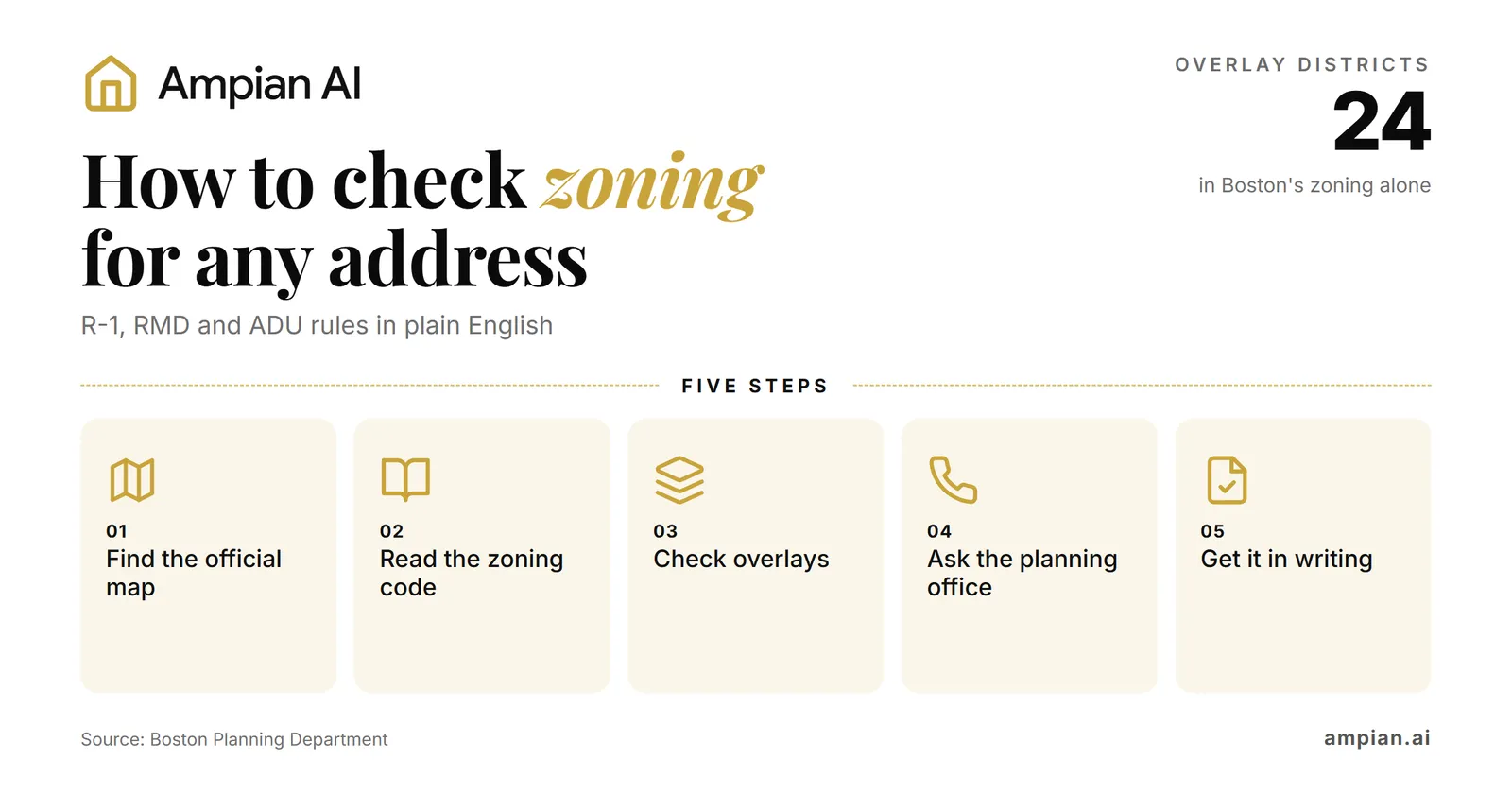
To check the zoning for any address, find the property on the city or county’s official zoning map, read the rules for the property’s district, check for additional rules called overlays, and confirm your findings with the planning office (Boston alone has 241). Get written confirmation if your purchase depends on what you can build or how you can use the property.
Zoning labels vary by location. R-1 and RMD can mean different things in different cities, so always read the local definition. The five steps below explain where to look, followed by examples of common zoning labels and rules for adding another home.
Key takeaways
- Start with the official city or county zoning map, not a listing site. Boston’s free Zoning Viewer, for example, identifies the property’s district, subdistrict and overlays2.
- Read the zoning code for that district. It explains allowed uses, building height, distance from property lines and the number of homes permitted.
- “R-1” usually means one single-family home per lot, but state law may allow additional units, such as accessory dwelling units (ADUs). In California, for example, a city must allow an ADU on a lot zoned for single-family or multifamily homes3.
- “RMD” has no national definition. Redondo Beach, California, uses it for a district that allows condos, duplexes and apartments4. In Newfield, New Jersey, it allows only single-family detached homes5.
- ADU rules vary widely by location. California law makes cities allow at least an 800-square-foot ADU3. Boston allows ADUs only inside existing space of owner-occupied homes, except where newer neighborhood zoning allows more6.
- Houston has no city-wide zoning ordinance7. The city helps enforce recorded deed restrictions instead, and those change from subdivision to subdivision8.
- If your purchase depends on zoning, ask whether the city or county can provide a zoning verification letter and address your specific plans.
Step 1: Find the official zoning map for the address
First, identify which local government handles zoning for the property. This is usually the city or town, or the county if the property is outside municipal boundaries. Then find its official zoning map. For example:
- Boston: Open the Planning Department’s Zoning Viewer. Search by address or parcel ID, the number used to identify a piece of land2.
- San Francisco: Use the city’s Find My Zoning page to access its Property Information Map9.
- Austin: Search by address in the city’s Property Profile tool to see zoning and other property information10.
Online maps may not include the latest changes. Boston says it updates its viewer monthly. If the viewer conflicts with the official signed zoning maps and amendments, those official records take priority1.
Write down three things from the map: the district name, any sub-district, and the article or chapter of the code it points to. A subdistrict is a smaller area with its own zoning rules.
Before you offer: Check the properties beside and behind the home as well. Their zoning can help you understand what might be built nearby. Our essay explains why what can be built next door is already in the zoning code.
Step 2: Read the district’s rules in the zoning code
Use the district name to find the relevant section of the zoning code. Cities often publish their codes through services such as Municode, eCode360 or American Legal Publishing. Boston’s whole zoning code is on Municode11. Houston’s official zoning letter points to its Code of Ordinances on Municode too7. Redondo Beach, California, publishes its planning and zoning title on eCode3604.
Inside the code, look for two types of tables:
- The use table. This shows which activities and building uses are allowed. Boston marks each use with a letter: “A: Allowed,” “C: Conditional,” which needs a conditional use permit from the Zoning Board of Appeal, and “F: Forbidden,” which is not allowed without a variance2. A variance is an approved exception to a zoning rule2. An allowed use may still require building permits.
- The dimensional table. This sets building and lot limits, including height, number of stories and setbacks—the required distance from property lines. Under Redondo Beach’s Chapter 2 RMD rules, for example, no building may exceed 30 feet4 or two stories4. Check whether other rules or approvals change the limits for your project.
Make sure you are reading the right chapter. Redondo Beach has separate zoning provisions in Chapter 2 and Chapter 5, which applies to the coastal area12. Ask the city which applies to the property.
Before you offer: Check the allowed uses for a home office or rental unit, and the size and placement limits for an addition. If your plans need special approval or an exception, allow extra time and do not assume approval is guaranteed.
Step 3: Check for overlay districts
An overlay district adds rules to the property’s main zoning district. These may address flood protection, historic buildings or design review. Boston’s guide describes them as “special overlay districts that add extra rules on top of the base zoning”2, and the city’s zoning includes 24 overlay districts1. One of them is the Coastal Flood Resilience Overlay District, covered by Article 25A of the city’s zoning code1.
Check every overlay listed for the property and turn on any relevant map layers. Read the linked rules, then ask the planning office whether other restrictions apply.
Step 4: Call or email the planning office
Ask about approved exceptions, special permits and proposed zoning changes for the property. Boston notes that some earlier approvals are tied to a particular owner2. Also distinguish proposals from rules already in effect. Boston’s Neighborhood Housing initiative, for example, proposes changes beginning in Hyde Park, Roslindale and West Roxbury13. A rule you read today may not be the rule next year.
Have the address, parcel ID and a specific question ready, such as: “Can I build a detached ADU in the backyard?” Ask which approvals your project would need.
Step 5: Get it in writing with a zoning verification letter
Many cities issue a formal letter that confirms a property’s zoning. Austin’s Zoning Verification Letter identifies the current district and may include information about allowed uses or property-specific conditions. The city charges a fee and lists a typical processing time of 7–10 business days10. The letter’s scope matters: confirming a district does not approve a building project.
Check what the letter excludes. Houston’s citywide zoning letter, for example, does not cover separately recorded property restrictions7. Review deed restrictions—recorded rules about how a property may be used—and homeowners association (HOA) rules separately.
Before you offer: Request written confirmation early if you plan to add an ADU, run a home business or create another housing unit. Ask your agent or attorney about making the purchase conditional on confirming that your plans are feasible.
What common zone codes usually mean
These examples show how local definitions differ. Use the common meaning as a starting point, then check the rules for the address you are considering.
R-1: single-family residential
Common meaning: a single-family residential district, with one home per lot14. Other laws may allow additional units.
- Redondo Beach, California (R-1): the code sets a base limit of one home per lot, but also provides a process for qualifying two-unit projects under state law14. Separate rules allow qualifying ADUs and junior ADUs, which are smaller units within a single-family home15. The R-1 label alone does not establish the final number of homes allowed.
- Boston (1F): Boston uses different labels in its neighborhood codes. Hyde Park’s Article 69 defines 1F as a One-Family Residential subdistrict and sets a one-unit-per-building limit16. Check the current map and any separate ADU provisions before relying on that limit.
- Houston: there is no citywide R-1 zoning district. Houston has no comprehensive zoning ordinance, but certain areas, including land near airports, have specific land-use rules7. Other city development requirements and recorded deed restrictions may also apply8.
RMD: residential medium density (but not the same everywhere)
Common meaning: RMD often refers to residential medium density. Density means the number of homes allowed on a given amount of land. The label does not tell you which housing types are permitted:
- Redondo Beach, California: RMD allows housing such as condos, duplexes and apartments. Under Chapter 2’s base rules, lots smaller than 5,000 square feet allow one home; lots of at least that size allow no more than one home per 1,870 square feet of land4. Additional housing laws may affect that limit. RMD is also the label shown in Ampian AI’s sample report17; confirm the applicable chapter for any specific address.
- Jacksonville, Florida: The city’s summary covers RMD-A through RMD-D. All four allow single-family homes, while RMD-B, RMD-C and RMD-D also allow multifamily buildings, such as apartments18.
- Newfield, New Jersey: its RMD district lists detached single-family homes and municipal facilities as permitted main uses. The minimum lot size is 7,000 square feet5.
An RMD label can therefore allow apartments in one city and only detached homes as the main residential use in another.
ADU rules: accessory dwelling units
Common meaning: An ADU is “a smaller, independent unit inside your home or in your yard”6, such as a backyard cottage, a garage conversion or a unit in a basement or attic. California also has a “junior” ADU carved out of the house itself3. Check state and local requirements, along with any legally enforceable private restrictions.
- California (state law): The state sets a floor that every city must allow. The state housing department’s ADU Handbook (March 2026) explains that local size, lot coverage or setback rules cannot block “at least an 800 square foot accessory dwelling unit with four-foot side and rear yard setbacks”3. A city cannot set a height limit below 16 feet3 for a detached ADU. A junior ADU is “no more than 500 square feet” inside a single-family home3. When a home already stands on the lot, the city must approve or deny a complete ADU application within 60 days3. For most ADUs, a city “cannot impose an owner-occupancy requirement,” and HOA rules that “effectively prohibit or unreasonably restrict” an ADU are “void and unenforceable”3.
- Boston: The city’s planning site says Boston “currently allows owner-occupants to build an ADU using only existing space within their homes (such as within an unused attic or basement), without any exterior alterations”6. Mattapan’s zoning was changed to allow ADUs by right, “including detached ADUs, on owner-occupied residential lots”6. The Neighborhood Housing proposal would make a detached ADU in a rear yard easier to build13.
- Houston: There is no zoning district to check, but deed restrictions still apply. The city says they “adhere to subdivision lines and sometimes section or even lot boundaries,” and a copy comes from the county clerk where the property sits, which for most Houston homes is Harris County8. Read them before you plan a second unit.
Before you offer: If you need an ADU for family or rental income, check state law, local ADU rules, overlays, and HOA or deed restrictions. Ask the planning office about required permits, and confirm that your intended rental use is allowed.
Important limitation
How Ampian AI checks this
Ampian AI’s Zoning Oracle brings zoning and property information into one report with plain-language explanations. It uses Zoneomics for zoning and land-use data, according to About Our Data19.
In our free Zoning Oracle sample report, the Redondo Beach home is zoned RMD, Medium Density Multiple Family Residential, with “ADU Permitted: Yes,” “Multi-Family Permitted: Yes” and “Commercial Uses Permitted: No”17. The same report lists 5 active development projects17 reported nearby, plus flood and other hazard ratings for the address.
What it does not do: The Zoning Oracle does not read overlay districts, so check those with the city (Step 3). It is not a zoning verification letter, and the sample’s own fine print calls its figures “area-level estimates, not a guarantee for this exact property; verify locally before relying on them”17. Deed restrictions and HOA rules are separate records you get from the county clerk and the HOA.
If you want the zoning, nearby development and hazard picture in one place before you call the planning office, see Ampian AI pricing, or start with our home-buyer due-diligence checklist.
Frequently asked questions
What does R-1 zoning mean?
What does RMD zoning mean?
Can I build an ADU on my lot?
The zoning label alone cannot answer that. You need to check the applicable laws, the property’s size and layout, required permits, and any enforceable private restrictions. Ask the planning office about the type of ADU you want before including it in your purchase plans.
Is the zoning shown on a city map official?
A city map is an official source, but its online version may not reflect recent changes. Boston, for example, gives priority to signed zoning maps and amendments if they conflict with the viewer1. Ask the planning office which records control.
Sources
- Boston Planning Department, Find My Zoning and the Zoning Viewer
- City of Boston Inspectional Services, How to check a building's zoning designation
- California Department of Housing and Community Development, Accessory Dwelling Unit Handbook, March 2026
- City of Redondo Beach Municipal Code, Title 10 Chapter 2 Article 2 Division 2, Multiple-Family Residential Zones (eCode360)
- Borough of Newfield, New Jersey, Code Chapter 295 Article VIII, RMD Residential Medium-Density District (eCode360)
- Boston Planning Department, Enabling Accessory Dwelling Units
- City of Houston Planning and Development Department, Official City of Houston Zoning Letter, effective January 1, 2025
- City of Houston Legal Department, Deed Restrictions: Frequently Asked Questions
- San Francisco Planning, Find My Zoning
- City of Austin Development Services, Zoning Verification
- Boston Planning Department, Boston Zoning Code
- City of Redondo Beach Municipal Code, Title 10 Chapter 5 Article 2, Coastal Land Use Plan Implementing Ordinance zoning districts (eCode360)
- Boston Planning Department, Neighborhood Housing Zoning
- City of Redondo Beach Municipal Code, Title 10 Chapter 2 Article 2 Division 1, Single-Family Residential Zones (eCode360)
- City of Redondo Beach Municipal Code, Section 10-2.1506, Accessory dwelling units (eCode360)
- Boston Zoning Code, Article 69, Hyde Park Neighborhood District, posted by the Boston Planning Department
- Ampian AI, Zoning Oracle sample report
- City of Jacksonville, Florida, Residential Medium Density-A to D (RMD-A to RMD-D) district summary, updated February 18, 2025
- Ampian AI, About Our Data