Is There a Carfax for Houses? Where a Home's History Is Kept, and What It Leaves Out
A home's history is spread across insurance claims, building permits, property records, seller disclosures and the inspection. Learn how to check each, and why you still need to estimate future ownership costs.

Written by Toan Vo ·
This article was drafted with AI help, reviewed, and approved by Toan Vo.
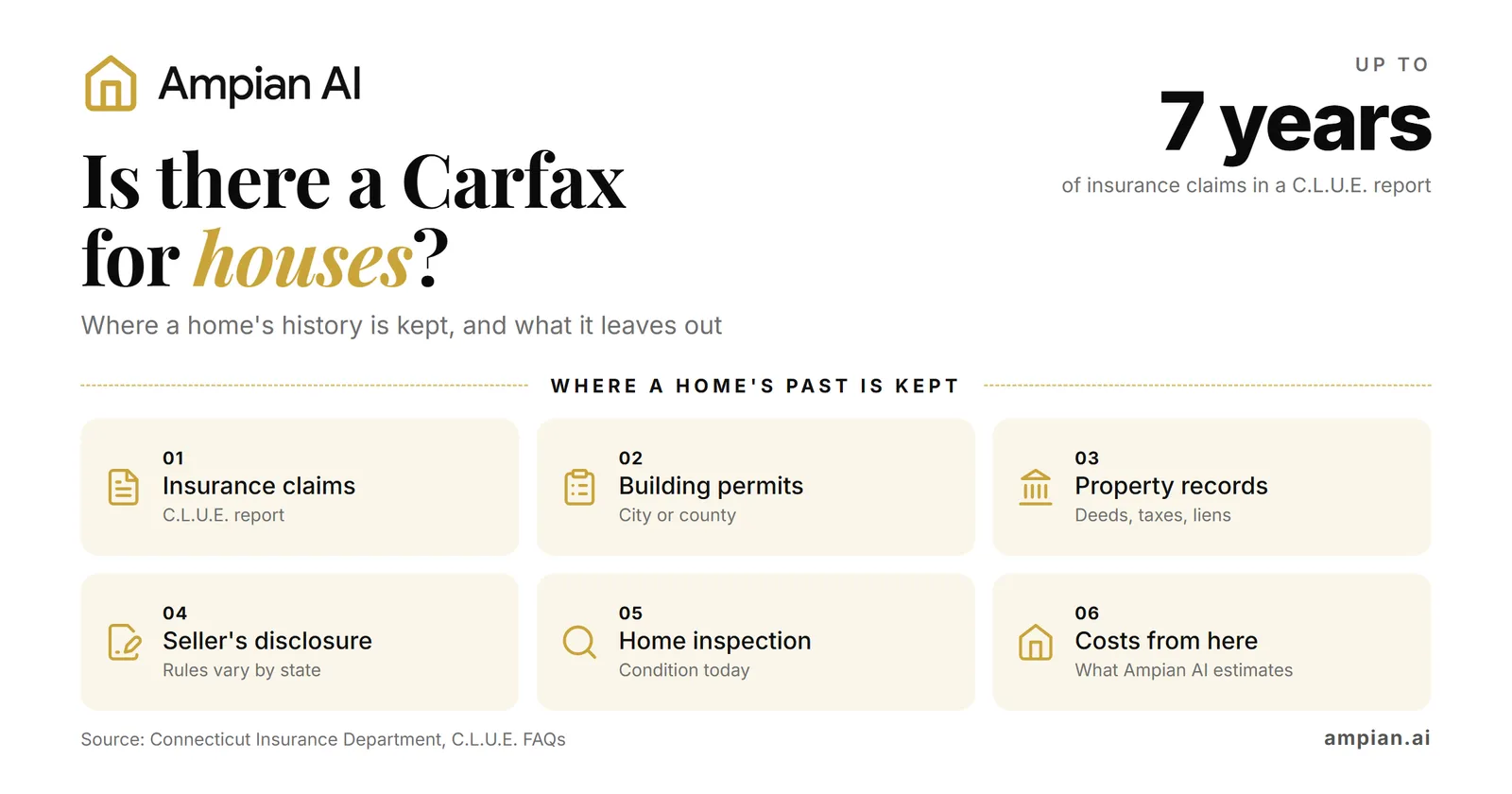
There is no single, complete history report for a house. A C.L.U.E. home insurance claims report can reveal past damage reported to insurers, but it covers only part of the picture. Buyers cannot order the seller’s report directly; they need to ask the seller for a copy of it1.
A home’s past is spread across five places: the insurance claims report, the city’s permit records, the county’s property records, the seller’s disclosure and your own home inspection. Together, they help you understand the home’s past and current condition. However, they still do not give you a complete budget for owning it.
Key takeaways
- A Carfax report checks a car’s reported accidents, service records, type of use and ownership history2. For a house, there is no single report like that. You need to check several sources from insurers, the city, the county and the seller.
- The C.L.U.E. report lists insurance claims on the property, including the date, type of loss and the amount paid1. Ask the seller to obtain and share it1.
- Permit records show work that was filed with the city. In Boston, for example, you can search by the property’s address7.
- Local property records show deeds, taxes and recorded liens. Owner’s title insurance can protect your investment against covered claims arising before your purchase, such as unpaid taxes10.
- Seller disclosure requirements vary by state and local law12. For most homes built before 1978, federal law requires a lead-paint disclosure in every state14.
- A home inspection assesses the property’s current condition, not its history. Arrange one rather than assuming the lender will do it for you15.
- These records help identify issues, but they do not provide a full ownership budget. Ampian AI estimates ownership costs and brings together zoning, natural-hazard and neighborhood information.
What a Carfax report does for a car, and why houses have no match
When you shop for a used car, Carfax helps bring reported accident, service, use and ownership information into one report2. Carfax also notes that it does not have the complete history of every vehicle2.
A home’s information is spread across several sources. Insurers report claims. Local building departments keep permits. Property-record offices record deeds and liens. Sellers may know about problems that never appeared in an official record. An inspector checks the condition of the home today.
So the honest answer to “Is there a Carfax for houses?” is no. But you can rebuild most of a home’s past yourself, if you know where to ask. Here is how to get each piece.
1. The insurance claims report (C.L.U.E.)
C.L.U.E. stands for Comprehensive Loss Underwriting Exchange6. LexisNexis Risk Solutions provides these claims histories to insurers to help them decide whether to offer coverage and what to charge5. For a home, the report lists claims on the property, including the date of loss, the type of loss and the amount paid1. Connecticut’s Insurance Department says it holds up to 7 years of personal property claims1. Utah’s Insurance Department says up to 5 years3. Check the dates on the copy you are given.
Who can order it. Buyers cannot directly order a C.L.U.E. report for a property they want to purchase. Connecticut’s Insurance Department says access is limited to the property’s owner, insurer or lender. Ask the seller to request and share a copy1.
How the owner orders it. Consumers are entitled to one free copy of their applicable report every 12 months. The owner can request it through LexisNexis’s online form, by mail or by calling 1-866-312-8076. After verifying an online request, LexisNexis mails instructions for accessing the report4.
What it can miss. The report is built on claims data from more than 90% of insurers that write homeowners coverage5. It is not a record of every repair or instance of damage. A leak repaired without a claim may leave no entry, and a report with no claims does not prove the house has never been damaged.
Before you offer: Ask the listing agent for a seller-provided C.L.U.E. report. The National Association of Realtors notes that buyers can ask the seller for a copy or make an offer contingent on a clean report6. For water or roof claims, ask for repair details, invoices and the contractor’s name.
2. Building permits
Permit records can help you check whether work described as “updated” was filed with the local building department. Look for the type of work, permit date and status. A permit application alone does not confirm that the work was finished or approved.
Start with the building department for the city or county where the house is. In Boston, for example, you can search historical permits by address7. The city also offers a document-image search and a separate database for permits issued after December 15, 20097. To see building plans, you have to visit the city’s document room in person7.
Permits have one big gap: work done without a permit does not appear on these records. For example, if a finished basement has no permit on file, ask the seller and the building department before drawing a conclusion.
Before you offer: Search for permits involving the roof, heating system, water heater and electrical panel. Compare the dates with the listing, and ask whether required final inspections were completed. Our guide explains why a repair fund matters for older homes.
3. County property records: deeds, taxes and liens
Local property records document ownership and recorded liens: legal claims against the property, often tied to an unpaid debt. Start with the county recorder or registry of deeds. The Consumer Financial Protection Bureau (CFPB) says property records can also show whether a mortgage lien has been released8.
Check the local assessor or tax collector for tax bills and assessed values: the property values used to calculate taxes. Boston’s Property Lookup tool, for example, provides both9. Keep in mind that the tax on the listing may reflect the seller’s bill. Our guide on whether your property tax will go up after you buy explains why yours can be different.
A title search checks ownership records and claims against the property. Owner’s title insurance can protect you against covered claims that began before your purchase, such as unpaid taxes or contractor bills10. Most lenders require a separate lender’s policy, which protects the loan. An owner’s policy protects your investment, subject to its coverage terms11.
Before you offer: Review the home’s assessed value and tax bills. Before closing, ask the professional handling your title search to explain any liens or unresolved claims. Review the coverage and exclusions before choosing an owner’s title policy.
4. The seller’s disclosure
The seller may know about a basement that floods, a patched roof leak or a fence dispute. A seller’s disclosure is a written statement that can bring these issues to your attention.
What a seller must tell you depends on where the house is. The National Association of Realtors says specific disclosures “are dependent on state and local law”12. Sellers are typically required to list completed repairs, natural hazards, property defects, land-use limitations and HOA guidance, among other things12. In most states, disclosures are often required before the buyer signs a binding contract12.
California is one example of a detailed form. Its Department of Real Estate says the Transfer Disclosure Statement is completed by the seller to describe the property’s physical condition and potential hazards or defects13.
Federal rules also apply to most homes built before 1978. Before the buyer signs a contract, sellers must disclose known lead-based paint and related hazards, provide available records and the required lead-safety information, and include the required warning statement. Buyers normally receive 10 days to arrange a lead inspection or risk assessment; they may waive that opportunity or agree in writing to a different period14.
Before you offer: Request the seller’s disclosure early and read it before making an offer, if available. Ask your agent or state real estate regulator which disclosures are required and when you should receive them.
5. The home inspection
Arrange an independent home inspection to assess the property’s condition. HUD explains that an inspector evaluates the home, identifies items needing repair or replacement, and can help assess the remaining life of major systems. Ask what the inspection covers and request a sample report before hiring an inspector15.
An inspection does not replace claims, permit or title research. An appraisal estimates the home’s value for the lender and does not replace an inspection. HUD’s guide notes that the EPA and the Surgeon General recommend radon testing for all houses, and suggests asking whether separate tests for lead, asbestos, water quality or pests are appropriate15.
Before you offer: Discuss an inspection contingency with your agent: a contract condition that lets you review the inspection results before proceeding, under the agreed terms15. Share permit records and past claims with the inspector so they can pay particular attention to those areas. Our home buyer due diligence checklist guides every step in order.
What about paid “home history reports”?
Some services combine public records and other property information into one report. Before paying, check which sources and years it covers, when the information was updated, and whether it includes insurance claims. Do not assume a paid report contains everything. Many underlying public records can be searched directly, although access and copy fees vary.
The other half: what the house will cost you from here
Even if you gather every record above, you still only have the home’s past. You know what broke and what was fixed. However, these records do not add up to a complete ownership budget or show everything that could change around the home.
That is where a house is different from a used car. A car report is mostly about what already happened. A house is a place you will pay for every month for years. Its property tax may change after the sale. Its boiler has a few years left. Its zoning decides what can go up on the lot beside it. That is the half Ampian AI works on: the home’s present risks and future costs.
How Ampian AI checks this
Our free Ampian AI True Cost Forecaster sample report covers an early-1900s house in Dorchester, Massachusetts. It estimates a typical annual ownership budget of $139,40316, within a range of $127,83916 to $150,96816, including mortgage payments (loan repayment and interest). The total includes $11,06716 to $17,616 a year16 set aside for major repairs and replacements. The largest repair allowance is for a boiler estimated to be 25 years old, with about 12 months of useful life left16. The set-aside for it works out to about $786.97 a month16. These are sample estimates, not actual bills or a predicted failure date. Use installation records and equipment labels to check age, and an inspection to assess condition.
Our free Ampian AI Zoning Oracle sample report covers a property in Redondo Beach, California. It lists RMD zoning, meaning Medium Density Multiple Family Residential, and identifies apartment-style housing and accessory dwelling units, or additional homes on the same lot, as permitted uses subject to local rules17. It rates flood risk as Minimal and earthquake risk as Relatively High17, and lists 5 active development projects reported nearby17. It also shows how area home prices have moved: up 9%17 to 47%17 over the past five years and 57%17 to 113% over ten17. These are sample findings, not guarantees about this property or future prices. Confirm building plans and project status with the city.
Ampian AI’s reports supplement the records above. What our reports do not do: they don’t pull the home’s insurance claims history, run a title search, replace a home inspection or read the seller’s disclosure.
Before you offer: Check the home’s history and condition, then use Ampian AI to help estimate ownership costs and research local risks. See Pricing for individual reports or monthly plans.
Frequently asked questions
Is there a Carfax for houses?
Home history reports exist, but no single report provides a complete picture. Check insurance claims, local permits, ownership and tax records, seller disclosures and a home inspection. Each answers a different question.
Can a buyer get a C.L.U.E. report on a house?
Not directly. Only the owner, the insurer or the lender for the property can order one. As a buyer, ask the current owner to order it from LexisNexis and share it with you.
How do I find out what work has been done on a house?
Search the permit records at the city or county building department, usually by the property’s address. Permits show work that was filed with the city. Work done without a permit will not be shown, so compare what you find with what the listing calls updated.
Does a home inspection show a house’s history?
Not really. An inspection looks at the home’s condition today and estimates how much useful life its major systems have left, but you still need separate records for insurance claims, permits and ownership issues.
Sources
- Connecticut Insurance Department, C.L.U.E. FAQs
- Carfax, Vehicle History Reports
- Utah Insurance Department, C.L.U.E. reports
- LexisNexis Risk Solutions, FACT Act consumer disclosure
- LexisNexis Risk Solutions, C.L.U.E. Property
- National Association of Realtors, CLUE report
- City of Boston Inspectional Services, How to find historical permit records
- Consumer Financial Protection Bureau, How do I check if my lien was released?
- City of Boston Assessing Department
- Consumer Financial Protection Bureau, What is owner's title insurance?
- Consumer Financial Protection Bureau, Shop for title insurance and other closing services
- National Association of Realtors, Consumer Guide: Seller Disclosures
- California Department of Real Estate, First Time Home Buyers
- U.S. EPA, Real Estate Disclosures about Potential Lead Hazards
- HUD and FHA, For Your Protection: Get a Home Inspection (form HUD-92564-CN)
- Ampian AI, True Cost Forecaster sample report
- Ampian AI, Zoning Oracle sample report