The Hidden Costs of Owning a Home: 8 Costs Buyers Miss Before Making an Offer
Owning a home costs more than the mortgage payment. Here are eight costs and risks buyers often miss before making an offer, from the property tax after a sale to heating, insurance, repairs, flood risk and zoning.

Written by Toan Vo · Last updated
This article was drafted with AI help, reviewed, and approved by Toan Vo.
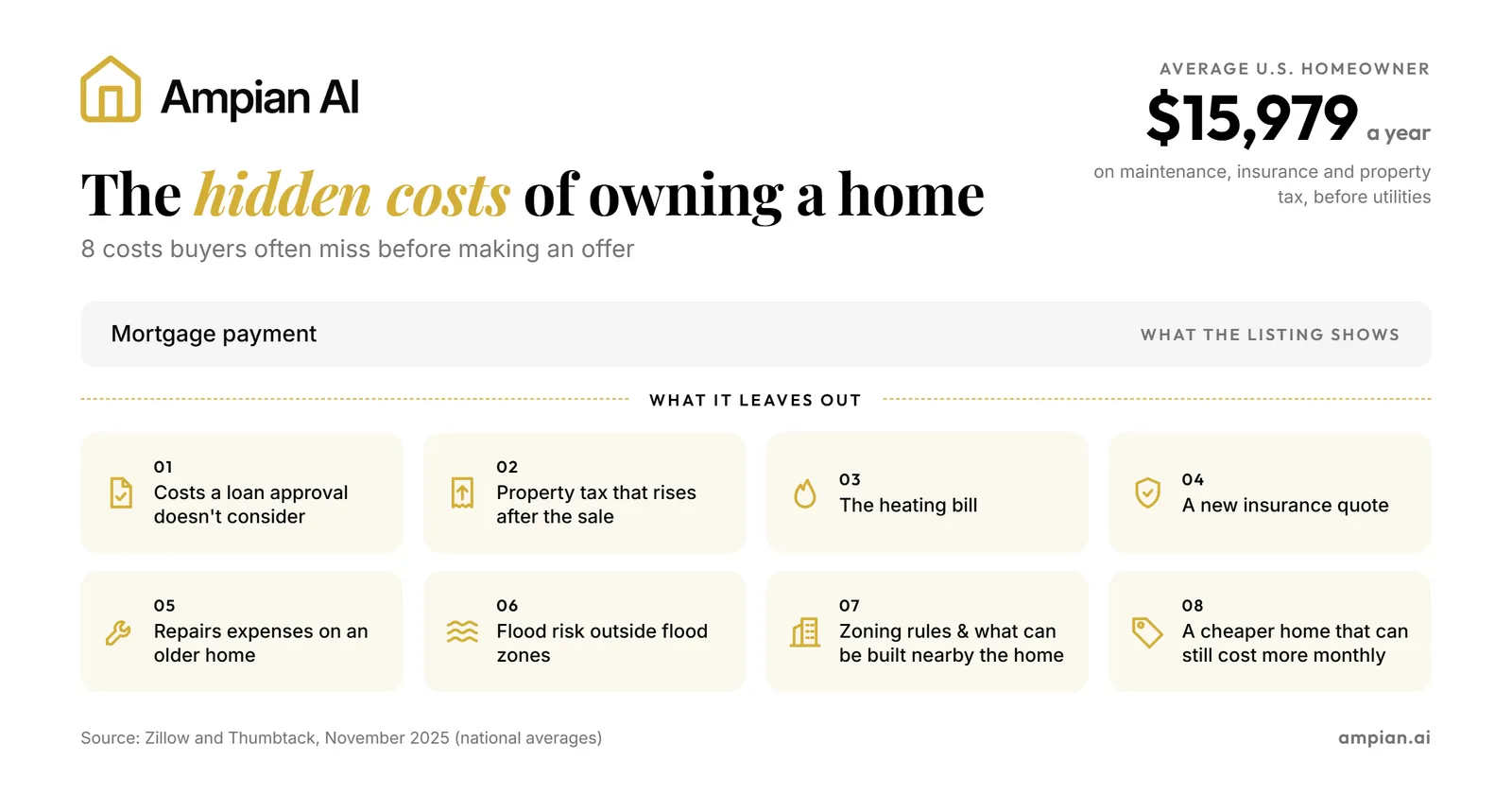
Owning a home is about much more than the mortgage payment. The average U.S. homeowner spends $15,979 a year on maintenance, insurance and property tax, according to Zillow and Thumbtack1. And that doesn’t include utility bills.
Before making an offer, buyers often overlook eight important costs and risks. The first four are ongoing expenses: costs that aren’t included in a typical loan approval, property taxes that can increase after a sale, the heating bill, and a new insurance quote. The other four are things that can affect your future expenses and quality of life: repairs on an older home, flood risk, what could be built nearby, and the possibility that a cheaper home could actually cost more each month.
Checking all of this by hand can mean searching through a dozen or more sources for every house. Ampian AI automates that research for any U.S. address, helping buyers check each home quickly before making an offer.
Key takeaways
- A mortgage pre-approval looks at your loan payment, property tax, insurance and HOA dues. It does not include utilities, upkeep, landscaping or snow removal. In our Ampian AI True Cost Forecaster sample report, $2,306 a month2 falls outside the costs a lender considers.
- The property tax shown on a listing is the seller’s bill. After you buy, your tax bill may increase based on your purchase price.
- Heating costs depend on the home’s heating systems and fuel. In our sample house, heating oil ranged from $1,8122 to $5,016 a year2.
- Your insurance quote starts fresh on the house you are buying based on its roof’s age, heating, wiring and hazards. Insurance premiums have risen 48% nationwide since February 20201.
- Older homes can require much more money for major repairs. Keep a repair fund separate from your emergency fund.
- A home outside a FEMA high-risk flood area can still flood. From 2014 to 2024, 29% of federal flood insurance claims came from outside high-risk flood areas3.
- Zoning rules determine what can be built on nearby lots, even if those lots look quiet today.
- A lower purchase price doesn’t always mean a lower monthly cost. In one example, an early-1900s house priced $151,500 less4 than a 2023 townhouse is estimated to cost $274 more per month4 to own.
The monthly cost nobody puts on the listing
When you buy a home, many people help you complete the transaction. Your agent helps you find and negotiate for the home. Your lender determines how much you can borrow. Your inspector looks for problems with the property. But none of them is responsible for telling you exactly what the house will cost your household every month.
That monthly number decides whether the house fits your budget or strains it. Many buyers only find it out after they’ve already bought the house. A house may fit within your mortgage approval but still stretch your budget once you add heating, electricity, insurance, maintenance, landscaping, snow removal and major repairs.
We think every buyer should know that number before making an offer. Here are eight things we’re working on at Ampian AI.
1. Loan approval isn’t the same as affordability
A mortgage pre-approval tells you how much a lender is willing to lend. It doesn’t tell you exactly what the house will cost you every month. Lenders generally consider the amount you borrowed, interest, property tax, homeowners insurance, and HOA dues or mortgage insurance. Utilities, maintenance, yard care and snow removal aren’t normally included, although VA loans use a separate test that estimates some maintenance and utility costs.
Take the early-1900s Dorchester house in our free True Cost Forecaster sample report as an example. Its estimated total cost is about $11,617 a month2. The costs a lender considers add up to $9,3112, leaving $2,306 a month2 that doesn’t show up in the mortgage approval. Sample figures use that report’s own purchase price and may not reflect current market conditions.
Your actual monthly cost will also depend on how you live. A family of four may use much more heating, cooling and water than one person who travels frequently for work. The size of the yard, the driveway and even how you use your thermostat can change the total.
How do you turn a loan approval into the full amount your family will actually spend on the home each month? And since that amount depends on how you live, how do you give an estimate that’s honest and still easy to plan around?
Before you offer: Get a new homeowners insurance quote. Add utilities, maintenance, yard care and snow removal to the monthly payment your lender gave you. Then decide what monthly cost you’re actually comfortable with before you start comparing homes.
2. The property tax on the listing isn’t necessarily yours
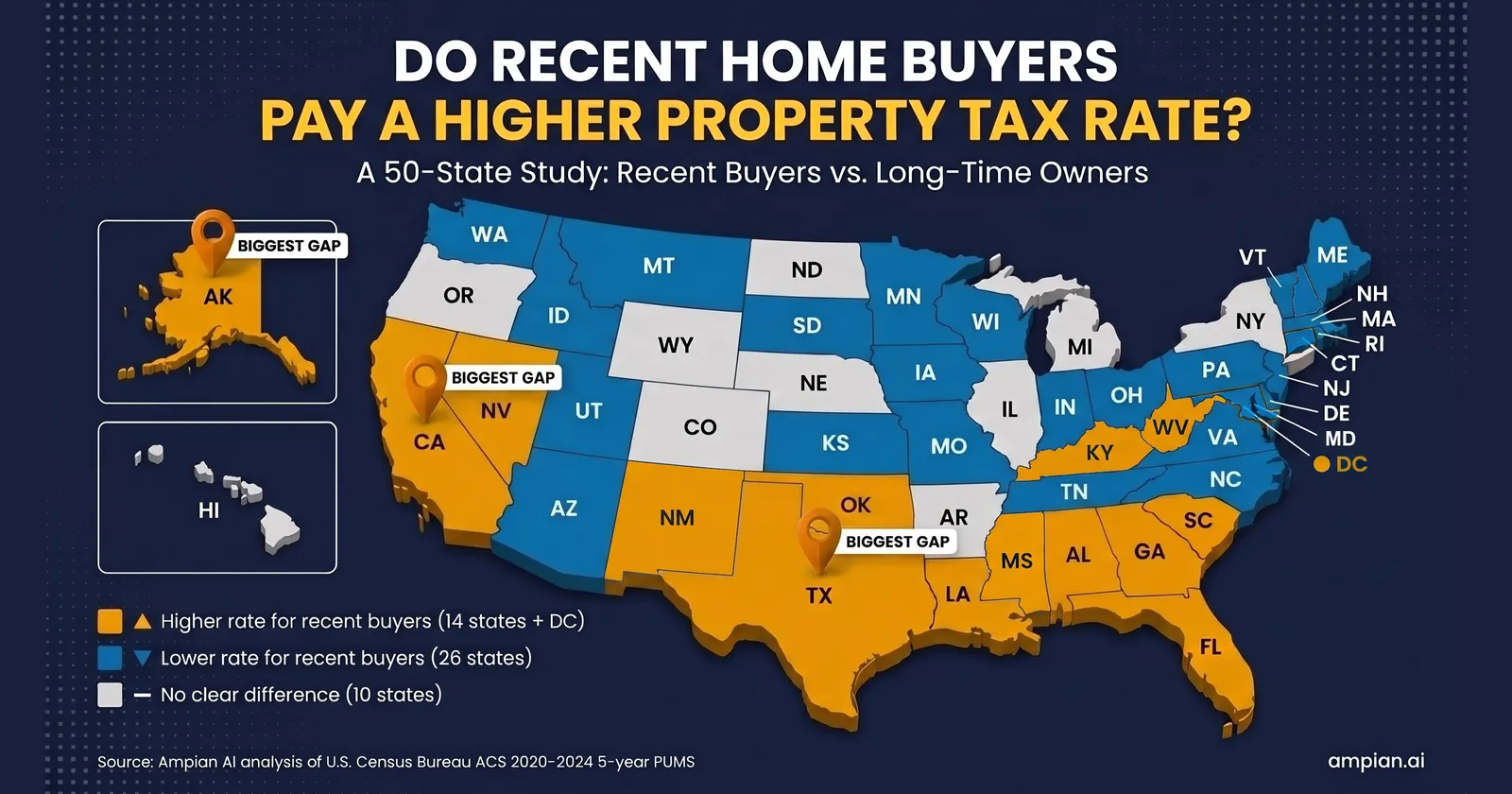
The property tax shown on a listing is what the current owner is paying. It may not be what you’ll pay after you buy the house. In many places, a sale can cause the home’s taxable value to be reassessed based on the new purchase price. Many of the seller’s exemptions and caps end when the house changes hands. Sometimes the higher tax bill doesn’t show up right away. It can arrive later as a shortage in your mortgage escrow account, which can cause your monthly mortgage payment to increase.
For example, one Boston home had a property tax bill of $12,000 a year17 before it sold. After the sale, the tax increased to $19,000 a year17 because the new assessment was based on the purchase price. That’s 58% higher17, or about $583 more per month17, by our math.
The exact rules depend on where you live. California reassesses a home to market value when it sells under Proposition 13, while Florida removes the Save Our Homes cap for a new owner. Maryland’s Homestead Tax Credit and Michigan’s cap on taxable value also end when a home changes hands.
That’s the hard part: thousands of local taxing jurisdictions each set their own rates, assessment cycles, caps and exemptions. At Ampian AI, we start with Census data on local home values and taxes, then apply each county’s rules, including owner-occupant exemptions.
How do you predict the bill a new owner will pay, not the one the seller paid, in every county? Which exemptions end at sale, and which can a buyer apply for again?
Before you offer: Ask the local assessor’s office how the home’s taxes could change after the purchase. Apply the local tax rate to your expected purchase price rather than simply using the tax number shown on the listing. You can also see how the tax line is worked out for a real house.
3. Nobody will mention the heating bill
A home’s heating cost depends on what fuel it uses and how many heating systems it has. That information usually isn’t included in the listing, and an inspection isn’t designed to tell you how much you’ll spend on heating each year.
Consider one Boston home with oil radiators, electric baseboards and a supplemental mini-split system. During winter, the heating oil alone cost about $600 a month17, while the electric bill also increased because of the baseboard heaters.
Our True Cost sample house has estimated heating-oil costs ranging from $1,8122 to $5,016 a year2, depending on the winter and oil prices. The full-year range includes summer months, when the house uses little or no heating oil.
The challenge is that you can’t look at the home’s utility history if the seller doesn’t provide it, and fuel prices change from season to season. We estimate energy use using the federal Residential Energy Consumption Survey and adjust the estimate based on the local climate and the home’s heating systems.
How close can a survey-based estimate get to one house’s real bills? How do you price three heat sources for a winter that hasn’t happened yet?
Before you offer: Ask what the house uses for heating and identify every heating system during your tour. Then ask the listing agent for the seller’s last 12 months of utility and fuel bills. Those bills can tell you far more about the home’s real operating costs than a listing can.
4. The seller’s insurance premium isn’t your quote
The seller’s homeowners insurance premium doesn’t necessarily tell you what you’ll pay. Your insurance company will look at the house you’re buying, including its roof, heating system, electrical wiring, construction, age and exposure to hazards. Your own insurance history and the insurer’s current rates can also affect the price.
In one example, a buyer budgeted $200 a month17 to insure an older Boston home and ended up paying $40017. The insurer priced in the oil heat, the old electrical panel and the house’s age.
Nationally, premiums have risen 48% since February 2020, according to Zillow and Thumbtack1. The Zebra’s 2026 State of Insurance report found that first-time buyers expected to pay about $2,6925 for homeowners insurance in 2025 but actually paid about $2,8875—about $195 more than expected5.
There isn’t a public database showing exactly what it will cost to insure every house. Insurance companies also change their rates over time. We estimate insurance costs using the home’s estimated cost to rebuild, U.S. Treasury Federal Insurance Office data and construction costs. We then adjust for the home’s age, systems and hazards.
How do you tell a buyer what insurance will cost before any insurer gives them a quote? And how do you show which parts of the house, like an old roof or an old furnace, push the price up the most?
Before you offer: Get an insurance quote before you commit to the house. When you contact an independent insurance agent, have these five facts ready: roof age, heating type and fuel, electrical panel, year built and square footage.
5. An emergency fund isn’t a repair fund
An emergency fund protects you from unexpected life expenses, such as losing a job or facing a medical bill. A home also needs its own repair fund. Major home systems eventually need to be repaired or replaced, and older homes can require significantly more money than newer ones. A simple rule of thumb that sets aside a fixed share of the home’s value each year doesn’t account for the actual age of the roof, heating system, water heater or other major components.
According to Zillow and Thumbtack, average U.S. homeowners spend $10,946 a year on maintenance1. In the two homes we compare in Section 8, the early-1900s house requires about $1,046 a month4 to be set aside for major repairs. The 2023 townhouse requires about $313 a month4.
The problem is that listings often say a home is “updated” without telling you exactly when the work was done. And different systems have different lifespans. A useful repair budget should consider when the home was built, how old its major systems are, and the cost of labor in your area.
How do you size a reserve when the listing doesn’t say how old the boiler is? How do you estimate when the roof, furnace and water heater will come due within a few years of each other?
Before you offer: Look at the age of the boiler or furnace and water heater. Check the equipment labels when possible, and search the city’s permit records for past replacements. If you can’t determine how old an important system is, consider budgeting conservatively rather than assuming it’s new.
6. “Not in a flood zone” doesn’t mean no flood risk
A house outside a FEMA high-risk flood zone can still flood, and a standard homeowners policy usually won’t pay for it. From 2014 to 2024, 29% of National Flood Insurance Program claims came from outside high-risk flood areas, according to FEMA’s FloodSmart3. FEMA also notes that most homeowners insurance excludes flood damage.
Flooding isn’t the only concern. Homes can also face wildfire and other natural hazards. Risk data also got harder to find. In November 2025, Zillow removed climate-risk scores from more than a million listings after pushback from real estate agents and a California listing service, according to TechCrunch and GeekWire. Zillow now links to its data partner, First Street, instead. At the time of TechCrunch’s report, Realtor.com, Redfin and Homes.com still displayed climate-risk information.
FEMA’s flood maps show officially designated flood areas, but those maps don’t capture every possible source of flooding. Other sources provide information about additional risks, including wildfire. Ampian AI combines FEMA flood information, National Risk Index data and U.S. Forest Service wildfire information for each address.
We’re still working on turning that risk into a dollar amount a buyer can budget for. How do you take FEMA’s flood map and a separate risk score and turn them into one clear answer for a single home?
Before you offer: Look up the address on FEMA’s Flood Map Service Center and the U.S. Forest Service’s Wildfire Risk to Communities site. Consider getting a flood insurance quote even if the home is outside a high-risk flood area. You can also see flood and other hazard ratings for one address in our Ampian AI Zoning Oracle sample report.
7. What can be built next door is already in the zoning code
When you look at a house, it’s easy to focus on what the neighborhood looks like today. But what can happen next door depends on the local zoning rules. A quiet lot next to your future home could potentially become an apartment building, an accessory dwelling unit or another type of development if local zoning allows it.
Our free Zoning Oracle sample report covers a home in Redondo Beach, California. The property is zoned RMD, or Medium Density Multiple Family Residential. That zoning allows apartment-style housing and accessory dwelling units. The same report also lists five development projects reported in the Redondo Beach area.
If neighboring lots have the same zoning, apartment-style housing could potentially be built beside the property. The challenge is that zoning rules are different in every city and town. They can also be spread across local codes, additional zoning rules, planning documents and PDFs, while information about new development may be scattered across local news sources. We get zoning information from Zoneomics and use AI to find recent development news from reputable news sources, giving buyers a clearer picture of what’s happening around a property.
How do you explain what a zone allows in plain English, anywhere in the country? How do you surface nearby development without passing along rumor?
Before you offer: Check the zoning for the property and nearby lots. Also look for additional zoning rules that could affect the property, and check the city’s planning agendas for nearby projects. A neighborhood that looks quiet today may not look the same five or ten years from now.
8. The cheaper house can cost more every month
A lower price doesn’t always mean a lower monthly cost. When comparing homes, buyers naturally look at the price, number of bedrooms, location and commute. But once you own the home, you’ll also have to pay for heating, insurance, maintenance, landscaping, snow removal and repairs.
We ran a case study to compare two homes in one Boston neighborhood, each with 20% down4, a 6% 30-year loan4 and a family of four. One is an early-1900s single-family with oil heat at $837,5004; the other is a 2023 townhouse at $989,0004.
The older house is $151,500 cheaper4, yet its estimated monthly cost is about $6,7544, compared with about $6,4804 for the newer townhouse, including the townhouse’s HOA fee. That’s a difference of $274 more every month4 for the less expensive house. Why? The older house has higher costs for heating oil, yard care and snow removal, along with a repair reserve that’s more than three times the townhouse’s.
To compare homes fairly, you have to add up every monthly cost for each one, not just look at the price. How do you show a buyer, right next to the price, what the furnace, roof and water heater will cost over the next ten years? And how do you help buyers find the home that costs the least to live in, not just the one with the lowest price?
Before you offer: Compare your final homes based on their estimated monthly cost, not just their listing price. Ampian AI Pro includes report credits every month while you shop.
Why this matters: the trillion-dollar line item
U.S. homeowners spend roughly $1.4 trillion a year on maintenance, insurance and property tax9. That’s based on about 87 million owner-occupied homes in the second quarter of 202610, according to Census data published by the St. Louis Fed, multiplied by the $15,979 yearly average1 from Zillow and Thumbtack. And that figure is before a single utility bill.
Yet many buyers still estimate their housing costs using the monthly payment shown on a listing or the amount their lender says they can borrow. The problem is that you don’t pay only the mortgage, you pay for the whole house. Knowing these costs before you make an offer can give you advantages. You may decide to:
- Ask for a lower price
- Ask the seller to contribute toward repairs
- Save more money before buying
- Choose a different home
- Walk away from a deal that no longer fits your budget
Run your first address
If any of these problems sound like the house you’re looking at, check these costs and risks before you make an offer.
Sign up for Ampian AI for free preview reports, no card needed, or open the full True Cost and Zoning Oracle sample reports first.
A few things that make Ampian AI different:
- Every number starts with named sources, such as FEMA, the Census Bureau, federal energy data and Zoneomics, listed on our About Our Data page.
- Each estimated cost is shown as a low-to-high range, not a single number, because what you actually pay depends on how you live in the home.
- We don’t sell your personal information to marketers or real estate brokers.
- Buy a single report, or use Pro for report credits every month while you shop, and cancel after closing. See Pricing.
Hit a cost we didn’t list? Tell us. It could be the next problem we work on.
Ampian AI automates the home-buying research that buyers would otherwise have to do by hand across a dozen or more sources. Our reports combine authoritative, reliable data sources with AI that explains the information rather than inventing it, helping buyers check a home in minutes.
Frequently asked questions
How much should I budget for the hidden costs of owning a home?
U.S. homeowners spend an average of $15,979 a year on maintenance, insurance and property tax, before utilities, according to Zillow and Thumbtack1. That’s about $1,325 a month1. In Greater Boston, the figure is $21,3201. Older homes and colder climates can cost more, so the best approach is to estimate the costs for the specific home you’re considering.
Why did my property taxes go up after I bought my house?
Property taxes often rise after a purchase because a sale can trigger a reassessment toward the purchase price. The seller’s tax caps and exemptions may also end when the property changes hands. New construction is also reassessed once it’s finished. The higher bill may not arrive immediately. When it does, it can create a shortage in your escrow account and increase your monthly mortgage payment.
Does a mortgage pre-approval include utilities and maintenance?
No. A typical pre-approval covers principal, interest, property tax, homeowners insurance, and any HOA dues or mortgage insurance. It leaves out utilities, maintenance, landscaping or snow removal, except on VA loans, whose residual-income test estimates them. Add those costs yourself to see what you can afford.
How do I check flood risk if a house isn’t in a flood zone?
Look up the address on FEMA’s Flood Map Service Center, then ask an insurance agent for a flood insurance quote. From 2014 to 2024, 29% of National Flood Insurance Program claims came from outside high-risk flood areas3. Most standard homeowners insurance policies don’t cover flood damage.
What should I check before making an offer on a house?
Start with the home’s true monthly cost rather than just the mortgage payment. Check the property tax you may pay after buying, the home’s heating systems and fuel, a fresh homeowners insurance quote, and the age of major systems such as the roof, heating equipment and water heater.
Then check flood and wildfire risk, what could potentially be built nearby, and the total monthly cost of each home you’re considering.
Sources
- Zillow and Thumbtack, Hidden costs of homeownership report, November 13, 2025
- Ampian AI, True Cost Forecaster sample report
- FEMA FloodSmart, flood claims outside high-risk areas
- Ampian AI True Cost reports on Boston homes, run by the author for this essay, 2026
- The Zebra, 2026 State of Insurance home report, April 21, 2026
- TechCrunch, Zillow drops climate risk scores after agents complained of lost sales, December 1, 2025
- GeekWire, Zillow removes climate data from home listings, but it's unclear why, December 1, 2025
- Ampian AI, Zoning Oracle sample report
- Our own math: the owner-occupied homes count (source 10) multiplied by the yearly average (source 1)
- Federal Reserve Bank of St. Louis (FRED), Owner Occupied Housing Units in the United States, Q2 2026
- California State Board of Equalization, Change in Ownership FAQ
- Florida Department of Revenue, Property Tax Information for First-Time Florida Homebuyers
- Maryland Department of Assessments and Taxation, Homestead Tax Credit
- Michigan Department of Treasury, Changes in Ownership and Uncapping of Property
- Ampian AI, About Our Data
- Ampian AI, Pricing
- First-hand Boston homeowner bills known to the author: property tax, heating oil and insurance